Digital magazine · Turn pages with the arrows or swipe. Use “Scrolling Article” for continuous reading.
THE PEOPLE’S FINE PRINT · OCTOBER 2026
Three cover stories. Practical tools. Questions worth discussing.
A publication by The Auxilium Firm
Publisher: Sharlisia Moore
THE BIG QUESTION · LET’S TALK ABOUT IT
FROM THE PUBLISHER
Sometimes the story is making national headlines. Sometimes it is happening down the street. And sometimes it belongs to a person sitting quietly beside us—someone carrying an experience they have never had the opportunity to explain.
I created The People’s Fine Print because I believe those stories deserve thoughtful attention.
There are questions people carry into hospital rooms, school meetings, workplaces, family conversations, and courthouses. What happened? Why did it happen? What information am I missing? Where can I turn to understand the process?
This publication is a place to explore those questions through people’s experiences, careful research, and honest conversation.
In this issue, we examine the financial burden of pursuing a disputed claim, the debate over young people’s role in elections, and questions about family and legal recognition surrounding Atatiana Jefferson’s story.
These are different subjects, but each asks us to consider whose voice is heard—and what we need to understand before reaching a conclusion.
You will also find practical information you can save and use to become more organized and better prepared. In future issues, we will introduce more community voices, interviews, and discussions.
Our responsibility is to tell these stories carefully: to distinguish what someone reports from what records establish, acknowledge unanswered questions, and correct mistakes when they occur.
My invitation is simple: read with curiosity. Ask thoughtful questions. Make room for an experience different from your own.
And if you have a story, we would like to hear it.
Sharlisia Moore
Publisher, The People’s Fine Print
A publication of The Auxilium Firm
Informed. Never Intimidated.
THE BIG QUESTION · LET’S TALK ABOUT IT
One collision. Two injured people. One claim reportedly settled. One still unresolved. When the money runs out before the dispute is resolved, is the outcome about the evidence—or who can afford to keep going?
Different claims can justify different outcomes. What evidence would distinguish a legitimate difference from unequal treatment?
COVER STORY · JJ VS TOYOTA
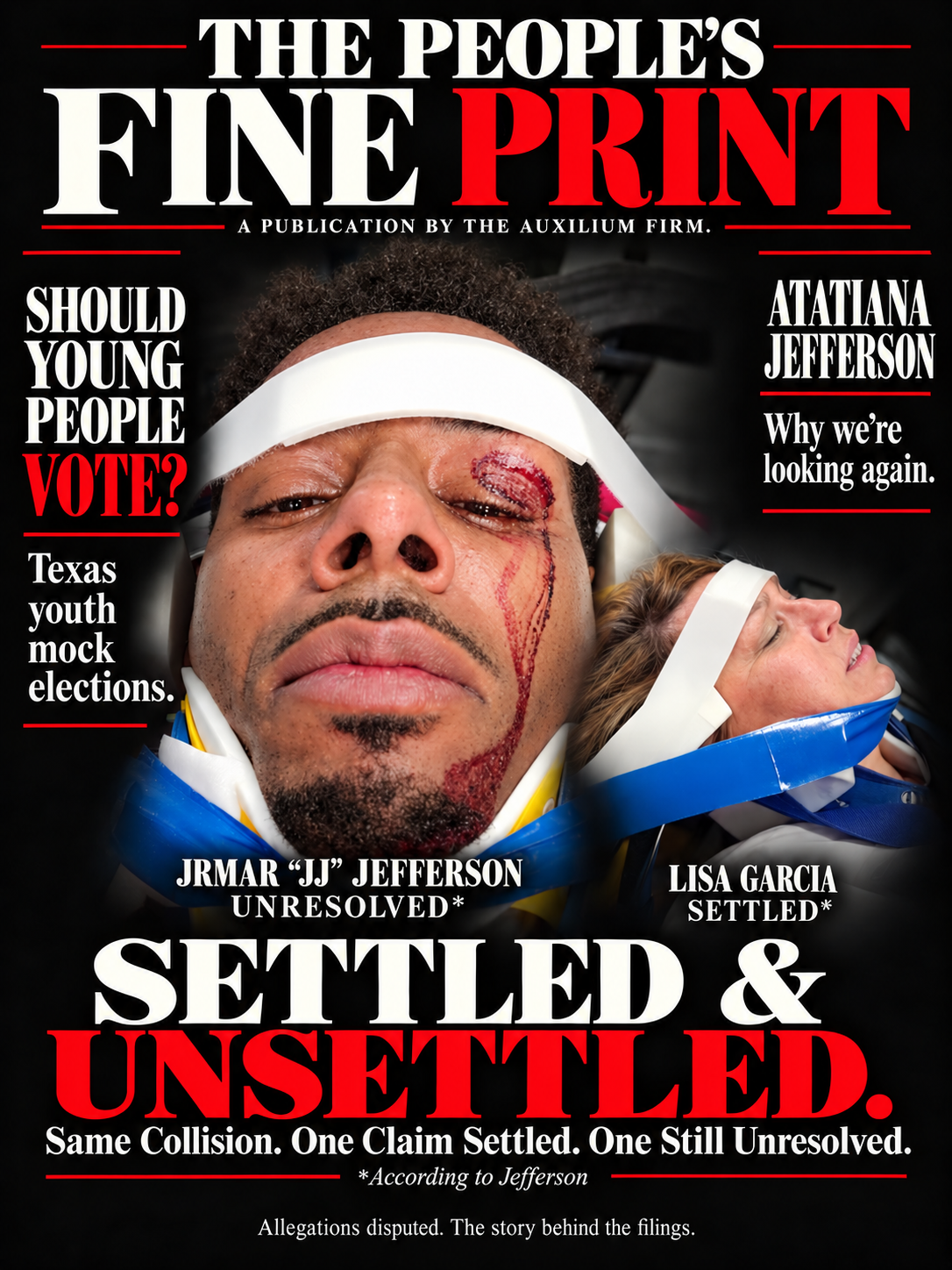
Same collision. Two injured people. One claim reportedly settled. One man still fighting to be heard.
Before there was a case number, there was a man strapped into medical restraints, his face injured, trying to get through the aftermath of a collision.
The photograph is difficult to look at. Jrmar “JJ” Jefferson wants people to look beyond it.
He wants them to understand what he says came next: difficulty getting continuing care, attorneys who stopped representing him, hundreds of requests for help, and the slow exhaustion of the money he had available to keep going.
Then there is the difference he cannot put aside. Jefferson says Lisa Garcia, the driver of the vehicle in which he was riding, settled her claim with Toyota. He says his own claim remains unresolved.
Two people injured in the same collision. Two very different paths afterward.
For Jefferson, the question is not simply why one case reportedly settled. It is whether a person without stable housing, strong financial resources, or continuing legal representation can afford to get his own evidence heard.
That is the story behind Settled & Unsettled.
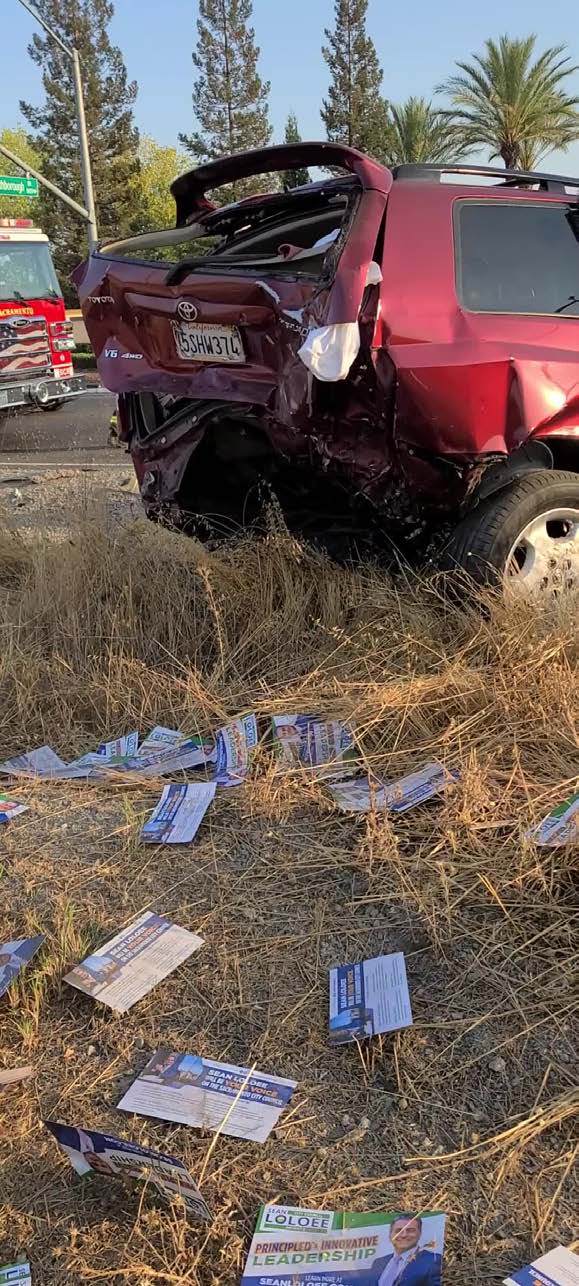
The collision happened on September 27, 2020, in Sacramento, California. Jefferson identifies Garcia as the driver of the Toyota Highlander in which he was a passenger.
He says he was experiencing homelessness at the time. He describes limited insurance coverage and difficulty obtaining continuing treatment during the COVID-19 pandemic and afterward. In his account, Garcia had better access to insurance, care, and legal representation.
This publication has not independently established those comparisons or the reasons for particular treatment decisions. What Jefferson describes is the strain of trying to recover while also trying to find help.
Getting through an emergency is one thing. Returning for care, gathering records, finding representation, and paying to pursue a claim can become another struggle entirely. Jefferson says that second struggle has stretched across years.
His story asks readers to consider the person behind the paperwork: someone who says he was injured, who believes the vehicle’s safety systems failed him, and who is still trying to secure the resources to prove his allegations.
The records supplied for this update add something important to Jefferson’s account: a documented sequence of emergency treatment and later evaluations. They describe more than the damage to a vehicle.
September 27, 2020: UC Davis emergency records document an eyelid laceration repaired with four sutures. The emergency history records a head injury and loss of consciousness. The physician’s discharge summary reports no acute injury on imaging and directs him to follow up with a primary-care provider. Those records show that he received emergency care; they do not establish that his treatment was inferior to Garcia’s.
October 2–3, 2020: Jefferson returned to UC Davis. The encounter records continuing brain fog, headaches, and neck and arm soreness. The clinical impression was postconcussive syndrome and musculoskeletal neck pain. Leaving the hospital after the crash had not ended the symptoms he was reporting.
April 27, 2021: In a comprehensive opinion report, neurologist Suresh Kumar described a pre-existing traumatic brain injury and cognitive difficulties, with symptoms aggravated after a second collision. The report describes worsening headaches, pain, and cognitive functioning. These are the clinician’s recorded opinions, not a finding by this publication about the cause of every symptom.
August 31, 2021: A Spine & Nerve Diagnostic Center consultation records continuing neck and lower-back pain, symptoms involving the arms and hands, and pain in several right-side joints. The clinician reviewed cervical MRI findings, including disc protrusions, and recommended further imaging and specialist evaluation. The history also records Jefferson’s report that COVID had made obtaining treatment difficult.
The records describe a 2018 collision and symptoms that existed before September 2020. That distinction matters. Jefferson’s account includes worsening of earlier problems as well as new symptoms; it would be inaccurate to describe every condition in his records as a new injury caused by this crash.
These documents support a history of treatment and continuing complaints. They do not, on their own, establish a defective seat, explain all of the injuries, or determine Toyota’s liability. Those questions remain disputed.
For readers, the human question remains: how does someone manage the work of pursuing a case while also dealing with the symptoms described in his medical records?
Jefferson supplied this short video as footage recorded after the collision. It shows his face and the damaged vehicle, bringing the account back to the person experiencing it.
Content note: visible facial injuries and blood. The video plays only when you choose to start it.
33-second video supplied by Jefferson. Its recording date has not been independently authenticated. The footage does not show the collision itself or establish how the seats and restraints performed during impact.
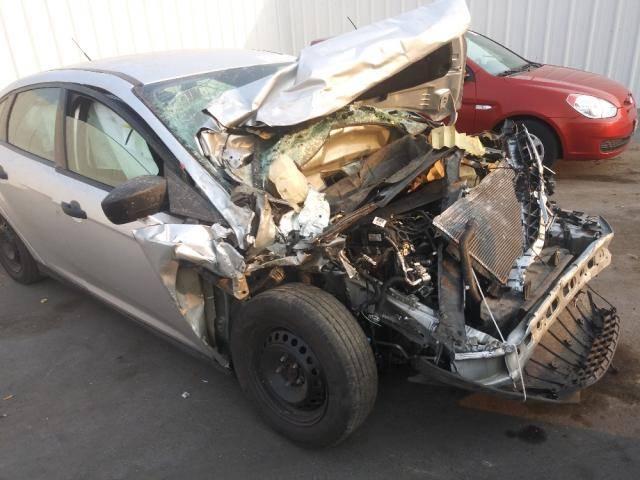
Jefferson describes a sequence of four impacts. He alleges that the driver’s seat moved backward, that Garcia was displaced toward the rear of the vehicle and lost consciousness, and that the vehicle continued moving without her control. He also alleges that both seats deformed toward the right and that the passenger restraint did not protect him adequately.
Those are disputed allegations. The supplied Toyota defendants’ answers deny his claims and assert defenses. The photographs of damaged vehicles do not, by themselves, establish a defect or explain which forces caused particular injuries.
Jefferson’s concern is the protection a passenger expects when getting into a vehicle. He wants the seat behavior, restraint performance, and sequence of the collision examined together.
Whether deformation in this crash reflected a defect, whether an alternative design would have changed the outcome, and whether the alleged behavior increased his injuries require evidence and competing expert analysis. This publication has not resolved those questions.
COVER STORY · JJ VS TOYOTA
Jefferson disputes the suggestion that he was unbuckled. He says he fastened his seat belt and has testified under oath that he was wearing it.
The September 27 UC Davis emergency note describes Jefferson as a “restrained passenger.” The note identifies the patient and emergency medical personnel as sources of the history. That is a contemporaneous medical entry relevant to his account; it is not an independent reconstruction of belt use or restraint performance. It should be considered alongside the other evidence rather than treated as the final answer to the dispute.
He points to his experience as an Uber driver—more than 10,000 rides, by his account—and describes wearing a seat belt as a consistent habit. That history does not independently prove belt use in this collision. It explains why he feels so strongly about the allegation.
He also says he heard no warning that the belt was unfastened. What that observation establishes depends on the equipment in this particular vehicle and how it operated; the absence of a warning alone does not settle the dispute.
For him, this is deeply personal. He wants his account considered alongside the physical evidence and the defense’s explanation, rather than having the question reduced to a suggestion he insists is wrong.
Jefferson says two law firms previously worked on the matter and later stopped representing him. He describes those departures as abandonment. The complete withdrawal records and the firms’ explanations have not been reviewed for this feature, so the reasons those relationships ended remain unverified here.
Afterward, he says, came more calls and more requests for help. He reports contacting more than 500 attorneys. That count has not been independently verified.
According to Jefferson, reasons given for declining included timing, proximity to trial, the demands of the litigation, and reluctance to take on Toyota. Those are his recollections, not statements independently obtained from the attorneys.
An attorney declining a matter does not establish whether its allegations are right or wrong. For the person seeking help, however, another unsuccessful inquiry can mean another day of trying to move forward alone.
Jefferson’s supplied third amended complaint identifies him as appearing on his own behalf. Behind those few words is the burden he describes: organizing records, trying to understand proceedings, and finding a way to pay for the next step.
Jefferson says Toyota settled Garcia’s claim while continuing to contest his. He also says the defense attributed some responsibility to the driver. The publication has not reviewed the settlement agreement or independently established the reasons for the reported resolution.
A settlement in one person’s case does not establish the merits or value of another person’s claim. Different outcomes alone do not prove discrimination.
But Jefferson believes the contrast warrants scrutiny. He calls his concern “consumer discrimination”: his belief that access to representation and resources can determine whose claim reaches a resolution and whose becomes an endurance test.
That is his interpretation. This publication has not established that Toyota’s decisions were motivated by race, insurance coverage, homelessness, or the absence of an attorney.
The question his experience raises does not require readers to assume that motive: what happens when the cost of presenting a case becomes more than an injured person can bear?
Having an opportunity to be heard and having the resources to use that opportunity can feel very different. Jefferson wants people to understand that distance.
COVER STORY · JJ VS TOYOTA
Jefferson says he has exhausted approximately $20,000 pursuing his case. He is now seeking $144,000, describing the effort as “144,000 stones”—one dollar per stone.
He estimates that a minimum of $60,000 is needed for the expenses of reaching trial. The larger goal is intended to support continued litigation and a possible appeal, if needed. These are his reported expenditures and estimates, not independently audited figures or guaranteed future costs.
The idea is that many small contributions could help him keep going when his own resources have run out. His appeal is for help pursuing the case—not a promise of a verdict, settlement, or financial return to contributors.
To support the broader need, donate to Your Unique Definition’s Justice Within Reach Litigation Assistance Fund. This is a separate program fundraiser, not a campaign earmarked for Jefferson’s personal $144,000 goal. The nonprofit selects eligible recipients and controls the use of funds.
Campaign inquiries can be directed to jj@jjvstoyota.com. The planned campaign domain is JJvsToyota.com.
YOUR TURN · KEEP THE CONVERSATION GOING
When one person from a crash settles and another is still fighting, what should explain the difference—the evidence, legal representation, or the ability to afford the fight?
Different claims can have different evidence and outcomes. But if one person cannot afford to develop and present the evidence, how equal is the opportunity to be heard?
Where do you draw the line between a legitimate difference between claims and unequal treatment—and what evidence would persuade you?
Consider both sides: What facts could reasonably explain different outcomes? What facts would raise concerns about unfair treatment? What would change your mind?
This is a discussion about access and fairness, not a request to decide liability from a cover story. A verdict requires the full evidence and applicable legal instructions.
Send your perspective →Responses are for editorial review. Please say whether we may quote you and how you would like to be credited.
Jefferson asks readers to imagine evaluating the case. What protection would you expect from a seat and restraint during a collision? What would you want to know before deciding whether that protection was adequate?
A fair evaluation would require the full record: the collision sequence, evidence of belt use, vehicle inspections, medical evidence, expert opinions, the defense’s evidence, and the applicable legal instructions. Photographs and one person’s account cannot replace that process.
Readers do not have to decide liability to recognize the human stakes of that process.
A person can survive a crash and still struggle to find a way forward. Jefferson is asking for the resources to keep pursuing his.
That is where this story continues.
We plan to speak with Jefferson about the collision, his search for counsel, and his fundraising plans. No interview date has been announced. Further coverage can examine supporting documents, the current procedural status, and responses from the people and organizations discussed.
The following passages were checked against the supplied records. The complete medical files are not published here because they contain private information.
The recall packet supplied with the materials includes a November 10, 2022 notice concerning certain seat-belt service parts. Its applicability to the belt in this September 2020 collision has not been established. It is not presented here as proof that this vehicle or belt was recalled.
This feature draws on Jefferson’s account provided to The People’s Fine Print, his supplied four-page case summary, his supplied third amended complaint, the supplied Toyota entities’ answers, medical records reviewed for this update, and photographs and video provided for publication. The filings identify Sacramento Superior Court case numbers 34-2021-00311004 and 34-2022-00325754.
Toyota Motor North America, Toyota Motor Sales, U.S.A., and Toyota Motor Engineering & Manufacturing North America deny the allegations in the supplied answers and assert defenses. Their position is drawn from those filings, not a new interview with this publication. Allegations are not findings of liability.
The reported settlement, comparative access to care, attorney-outreach count, explanations for representation ending, and financial estimates have not been independently verified. The current court docket has not been independently checked for this feature. Private medical files and personal identifiers are not reproduced.
Relationship disclosure: Jefferson has appeared in The Auxilium Firm’s team materials and is associated with the Yaka & JJ Show featured in this publication. The People’s Fine Print is published by The Auxilium Firm.
We welcome documentary corrections and responses at contact@theauxiliumfirm.com. Updated October 4, 2026. Editorial content is not legal advice.
THE BIG QUESTION · LET’S TALK ABOUT IT
THE EVERYDAY FILE
An important experience rarely arrives in one neatly labeled folder.
It arrives as a text message, a receipt, an email attachment, a photograph, a letter, or a conversation you thought you would remember. Weeks later, you may know exactly how the experience felt but struggle to put the events in order.
Organizing your information can make it easier to explain what happened and prepare for a conversation with an appropriate professional. You do not need an elaborate system. Start with five simple steps.
Choose a clearly named folder, such as “Hotel Stay — October 2026” or “Home Repair — Main Street.” Within it, separate correspondence, photographs, receipts, and other documents.
Use a protected location for private information. A public sharing link is not a suitable home for confidential records.
Write down the date, what happened, who was involved, and which document relates to that event.
A basic entry might read: “October 3: Sent an email reporting the problem. Copy saved in Correspondence.”
If you are uncertain about a date, mark it as approximate. Separate what you personally observed from what someone else told you.
Keep original emails, messages, photographs, and documents when available. Work from copies when adding highlights or notes.
A cropped screenshot may leave out context. Save the fuller conversation as well, where possible, and note where it came from. Avoid changing an original file to make it easier to present.
After a conversation, record whom you spoke with, the date, what you discussed, and any next step mentioned.
Identify your notes as your recollection rather than a verbatim quotation unless you have an accurate record of the exact words. Keep copies of written requests and responses together so you can see what remains unanswered.
That overview does not replace the underlying documents. It gives someone a starting point for understanding them.
Set aside fifteen minutes each week to file new material and update your timeline. Name files so you can recognize them without opening every attachment.
Organization does not establish that a claim is valid or guarantee a particular result. It helps you communicate more clearly and notice missing information.
Try this today: Find one unresolved issue in your life and create its folder. Add the first three documents. Write the first three timeline entries.
THE BIG QUESTION · LET’S TALK ABOUT IT
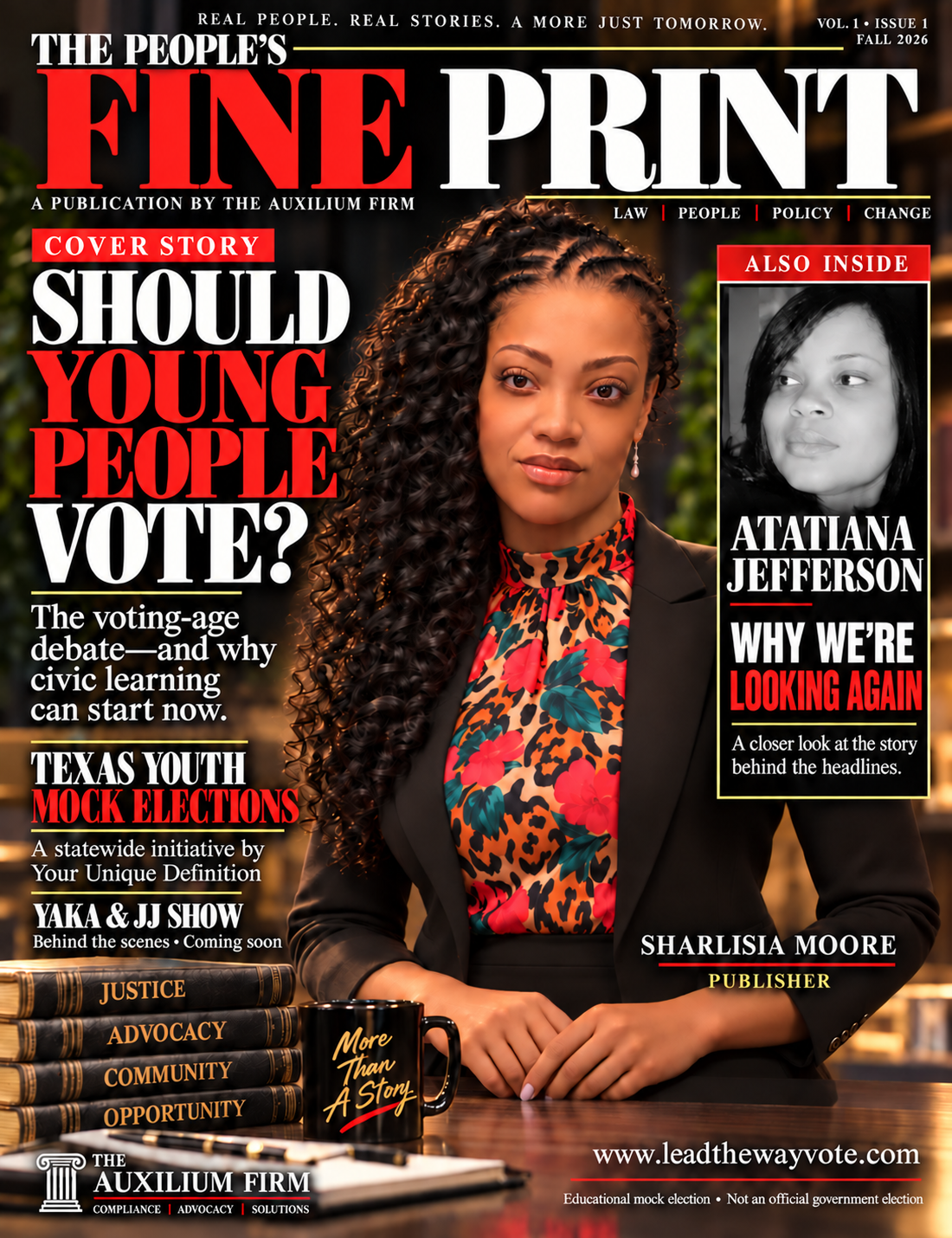
Young people live with the consequences of decisions they cannot vote on. Would an earlier voice make local government more accountable—or create new concerns about readiness and independence?
Where would you draw the age line, and why? Explore the arguments, current rules, and what Texas students can learn through mock elections.
YOUTH VOICES · SHOULD YOUNG PEOPLE VOTE?
A school-board decision can shape a student’s classroom long before that student can vote for a board member. Decisions about community resources, transportation and public priorities also reach young people who have no official ballot. That gap between being affected and being represented gives the voting-age debate its urgency.
Should the voting age remain 18? Should 16- and 17-year-olds have a vote? What about a proposal beginning at 14 for certain local elections? Those are different questions, with different practical consequences. Treating every person under 18 as one group makes the conversation less useful. A serious proposal must say which ages, which offices and which rules it would cover.
This feature examines the choices rather than asking readers to accept a predetermined answer. It also considers a step communities can take now: helping students practice informed, independent civic participation through an educational mock election.
Texas’s current voter-registration guidance says an applicant may register at 17 years and 10 months, but must be 18 on Election Day. Other eligibility requirements also apply, including citizenship and county residency. Registering before an eighteenth birthday is not permission to vote in an election held before that birthday. The Texas Secretary of State’s eligibility page is linked below. [1]
The Twenty-sixth Amendment, ratified in 1971, protects the voting rights of United States citizens age 18 and older against denial or restriction because of age. Its history includes the argument that young people old enough to be drafted should have a political voice. That historical debate shows that voting-age rules have changed before; it does not settle every argument for changing them again. [2][3]
An educational program cannot change official eligibility. Neither a mock ballot nor a student participation record authorizes a child to vote in a government election. A proposal for earlier official voting would require a lawful change through the appropriate governmental process.
YOUTH VOICES · SHOULD YOUNG PEOPLE VOTE?
The strongest case for earlier voting starts with representation. Young people have firsthand knowledge of school conditions and concerns about the future. Supporters can reasonably ask why that experience should be heard in a public meeting but excluded from the final electoral choice. For school-board elections in particular, the people receiving the education have a direct stake in its direction.
Another argument concerns preparation. Starting participation while students have access to structured civic learning could connect lessons about government to a concrete decision. Supporters hope that earlier participation would encourage lasting engagement. That is a goal worth examining, not an outcome that should be promised without evidence.
The case also challenges a familiar double standard: adults can vote without demonstrating expertise in every policy area. Young people should not have to prove perfect knowledge to deserve serious consideration. Still, showing that some teenagers are informed does not by itself determine the best age rule for every election.
Opponents may see 18 as a clear, understandable boundary connected to adulthood. They may question whether younger voters have enough independence from parents, teachers, peers or online personalities. Those concerns should be addressed directly rather than dismissed as hostility toward youth.
Influence is not unique to teenagers, but their dependence on adults creates particular questions. Would a student feel free to disagree with a teacher who leads an election activity? Could a parent pressure a child to reveal a choice? Any youth civic program should protect private choices and make clear that disagreement will not affect grades, access or standing.
Access is another concern. A well-resourced school may provide extensive civic instruction while another has limited time or materials. A fair discussion should ask how students outside traditional classrooms, students with disabilities and students with limited internet access would participate. Lowering an age threshold alone would not solve those differences.
School-board and municipal elections offer a concrete place to discuss the connection between public decisions and daily life. A proposal limited to local elections is narrower than one covering every state and federal office. But narrower does not mean simple: policymakers would still need clear eligibility, registration, ballot and administrative rules.
There is a real example of a local distinction. Takoma Park, Maryland, allows residents age 16 and older to register and vote in its city elections. Its official election information distinguishes city voting for mayor and council from county, state and federal elections. That example should not be described as a rule applying throughout Maryland or as permission for Texas teenagers to vote. [4]
A proposal to begin at 14 would need its own explanation. Evidence about older teenagers cannot automatically establish readiness at a younger age. Advocates should define the intended benefit and explain how they would address implementation and independent choice; critics should respond to that actual proposal rather than an exaggerated version of it.
YOUTH VOICES · SHOULD YOUNG PEOPLE VOTE?
Families and schools can teach meaningful participation without waiting for the voting-age debate to be resolved. Start with the office: what can a school-board member, mayor or legislator actually decide? A compelling promise means little if the office has no authority to carry it out.
Then compare sources. Read the same basic information about each candidate or position. Separate a proposal from a proven result, a campaign statement from independent reporting, and a personal opinion from a documented fact. Ask what information is missing and what could change your mind.
Finally, practice respectful disagreement. Students should be able to explain a choice without mocking someone else’s family, identity or beliefs. Adults can ask questions and provide factual corrections while leaving the decision to the student. The aim is a reasoned choice, not the answer an adult prefers.
Your Unique Definition’s Lead the Way initiative is offering a statewide Texas youth mock election in 2026. It gives students an educational opportunity to make mock choices and identify concerns that matter to them. The program is separate from official government elections and official voter registration. [5]
The program website lists early mock voting for October 19–30, 2026, and Mock Election Day for November 3, with voting closing at 7:00 p.m. Central. It asks students to participate once—during early mock voting or on Mock Election Day, not both. Check the program site for current availability and instructions. [5]
For this season, the site says no registration, voter ID or email is required for the mock ballot. Participants may also share up to five student concerns, ranked by importance; that portion is optional. Registration and voter-card activities are paused for this season, and existing students have a separate learning-hub link. [5]
These access choices come with a limitation the program identifies openly: without voter accounts, repeat participation across devices cannot be fully prevented. The results are an informal educational exercise, not a scientific poll or a prediction of an official election. Statewide availability does not mean the participants represent every Texas student. [5]
YOUTH VOICES · SHOULD YOUNG PEOPLE VOTE?
A mock election’s value is larger than the winning tally. A useful follow-up asks whether students can explain the responsibilities of an office, identify a reliable source and describe a tradeoff behind their choice. It also asks what they learned from someone who disagreed.
Educators and community groups can discuss issues before the activity, offer balanced source materials and allow students to keep their choices private. Participation should support learning rather than function as an endorsement of a candidate, party or particular view about lowering the voting age.
Afterward, treat the results carefully. Report who participated and what the exercise can and cannot show. A voluntary mock ballot may reveal concerns among participants, but it cannot establish what all children believe or prove that a particular voting age is correct. Students deserve that distinction as much as adult readers do.
The debate should leave readers with better questions: Which decisions affect young people most directly? What would earlier voting improve? What difficulties might it create? What age and election type are actually being proposed? What evidence would support changing the rule—or keeping it?
The People’s Fine Print’s editorial view is that young people deserve serious civic education and opportunities to be heard, whether or not the official voting age changes. Listening is not the same as agreeing. Teaching participation means making room for informed disagreement and independent thought.
Visit Lead the Way to explore Your Unique Definition’s Texas youth mock-election initiative, review the current schedule and find the participation instructions. The next generation does not have to wait until its first official ballot to begin learning how public decisions work.
Early mock voting: October 19–30, 2026. Mock Election Day: November 3; closes at 7 p.m. Central.
Visit Lead the Way →Educational mock election only. Not official voter registration or a government election.
Reviewed September 30, 2026. This feature combines sourced factual background with editorial analysis. Arguments and recommendations are not presented as proven research findings. The People’s Fine Print is published by The Auxilium Firm; the featured Lead the Way program is operated by Your Unique Definition, a separate organization. Program details may change.
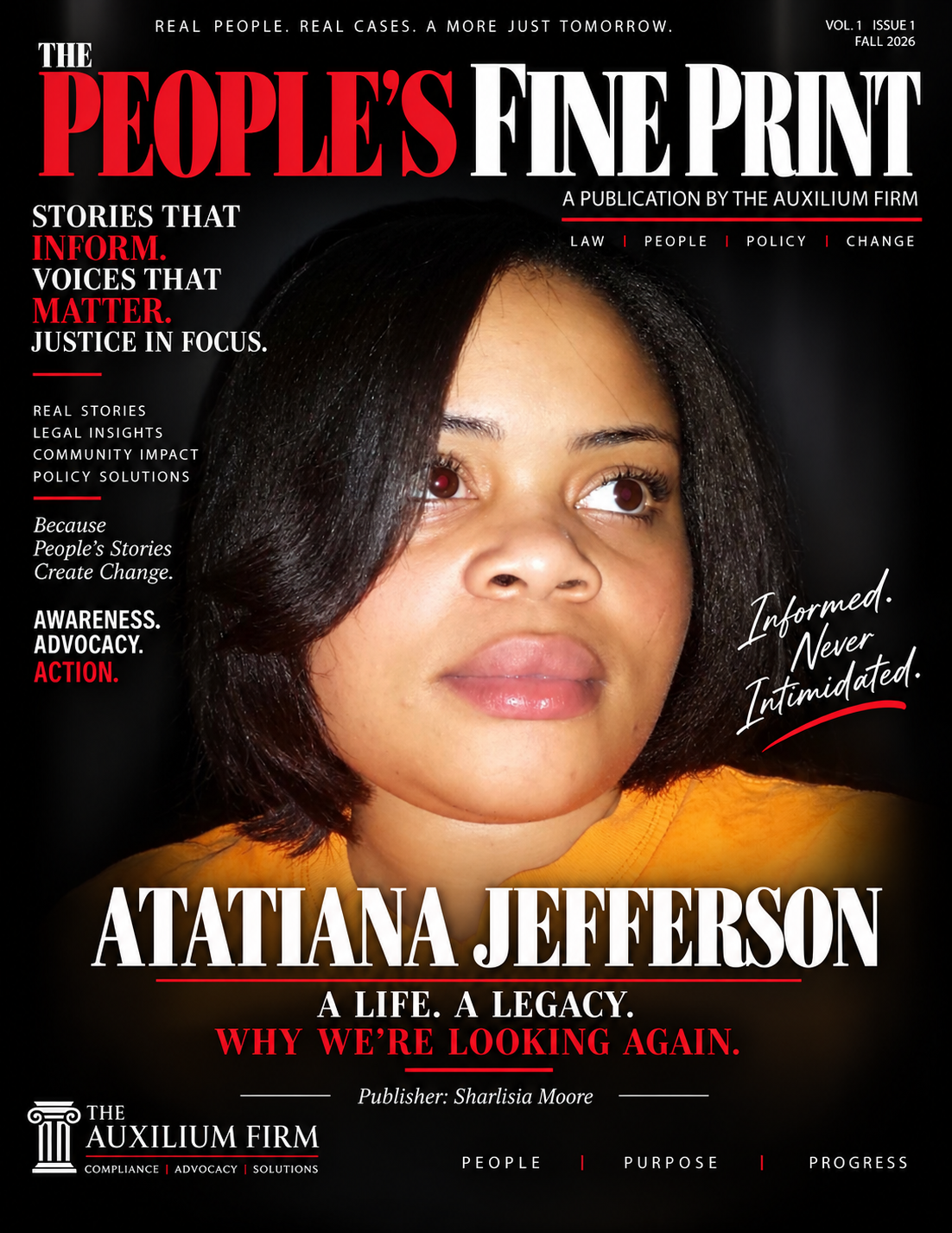
THE BIG QUESTION · LET’S TALK ABOUT IT
The family of Marquis Jefferson says he raised Atatiana and was the father she knew. It disputes a competing claim involving a man identified as her biological father, whose role in her life the family challenges. That dispute—not simply a look back at the headlines—is why we are returning to this story.
Should the answer turn on biology, legal parenthood, or the relationship lived day after day—and what happens when those point in different directions? The family’s account and the competing claims require documentary review; this question does not establish anyone’s legal entitlement.
We’re returning to Atatiana Jefferson’s story for a closer look at the questions behind the headlines. Our next feature will distinguish documented developments from the accounts and questions raised in interviews.
This is an editorial follow-up, not an announcement of a reopened court case or a verified new finding. The background feature below remains available while further reporting is prepared.
A life that matters beyond the headlines. A story that invites a new generation to read carefully, ask questions, and understand accountability.
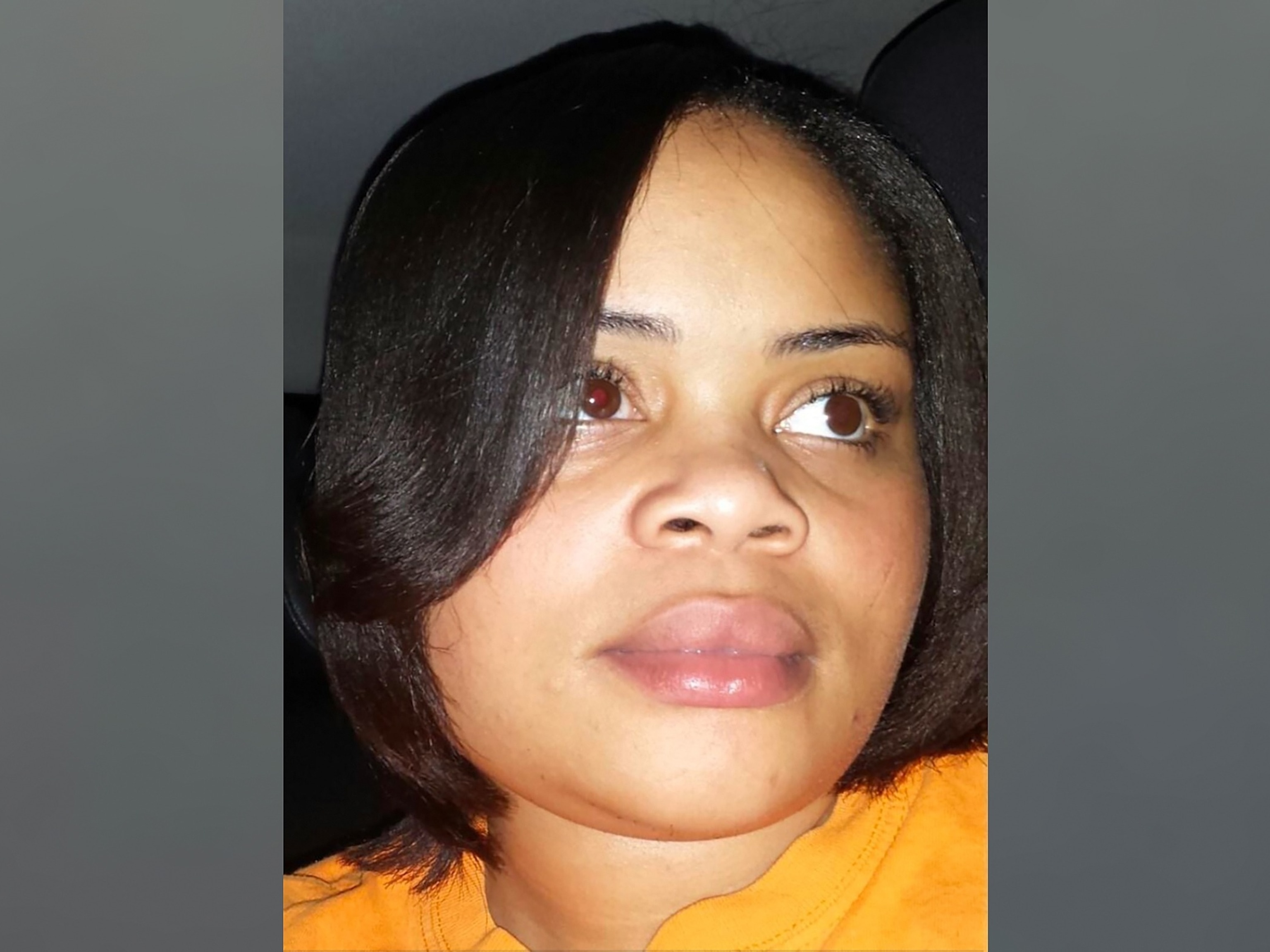
Before there was a verdict, a settlement announcement, or a headline, there was Atatiana Jefferson. Beginning with her life changes the way we read everything that follows. It asks us to see a person—not simply a case number or a dollar amount.
Jefferson was 28 years old when she was killed. She had graduated from Xavier University in New Orleans in 2014 with a biology degree. On the night of her death, she had been playing video games with her eight-year-old nephew. Those details describe a life with achievement, family, and everyday moments—not merely the events that ended it. [1]
On October 12, 2019, Fort Worth officer Aaron Dean fatally shot Jefferson through a window of her home. Officers had responded to a neighbor’s nonemergency call about an open door. Dean did not announce himself as an officer; Jefferson retrieved a gun after hearing someone outside. [2]
The setting is central to understanding why this story demands attention: a home, a family member nearby, and an encounter with police. Reading about it responsibly means resisting the urge to let a single headline do all the explaining. It means asking what the sources establish, what the proceedings decided, and where our own assumptions begin.
The public record of this story includes different proceedings over several years. Keeping their milestones separate helps readers avoid treating every development as the same kind of outcome.
A jury convicted Dean of manslaughter, rather than the murder charge on which he was tried. [2]
Dean received 11 years, 10 months, and 12 days in prison. [3]
Fort Worth authorized a $3.5 million settlement in the lawsuit brought for Jefferson’s nephew, Zion Carr. [2]
The City Council approved a proposed $11.25 million settlement concerning Jefferson’s death. Reporting at that time said probate-court finalization remained ahead. [2]
A large settlement figure can become the detail that travels farthest. It is easy to repeat and easy to turn into a headline. But it cannot describe the full meaning of a life, or tell readers everything they need to understand about a case.
For The People’s Fine Print, the more useful questions are also the more demanding ones: What happened? What has actually been established? What did a particular decision resolve? And how can the story be explained without turning uncertainty into accusation?
Those questions are not obstacles to a compelling story. They are what make the story worth trusting. Careful language leaves room for both compassion and precision.
Atatiana Jefferson’s case is the opening case study for The Juris Project, the youth legal-leadership program of Your Unique Definition.
High-school and college students are invited to move beyond the headline: study source material, distinguish evidence from allegations, examine competing arguments, and develop thoughtful responses through research, discussion, and mock hearings.
Why begin here? Because this story brings the human stakes of legal study into focus. It challenges students to care deeply while reading critically—to understand that a confident argument still needs reliable support.
The purpose is not to tell students which conclusion to reach. It is to help them ask better questions, explain their reasoning, and recognize how legal proceedings affect real people. Student activities are educational; they are not a criminal investigation or legal representation.
Your case. Your voice. Your future.
Explore The Juris Project & register →For students, these habits matter beyond a single assignment. They offer a way to approach difficult public questions with more care: read before reacting, separate what is known from what is assumed, and support an argument rather than simply making it louder.
Atatiana Jefferson deserves to be remembered as more than the subject of a proceeding. Beginning with her humanity does not take us away from the facts. It reminds us why getting them right matters.
The Auxilium Firm is following this story through The People’s Fine Print, with coverage focused on documented facts and clearly attributed information.
An interview with Ms. Jefferson is planned for this feature. The video is not yet available.
Return here for the conversation, captions, and a written transcript when published.
This feature draws on the published reporting linked below. Its educational commentary is presented separately from the reported milestones. Disputed parentage, inheritance, and fraud claims are not included.
Information reviewed September 22, 2026. This article is for public information and education, not legal advice. Corrections or documented updates may be sent to contact@theauxiliumfirm.com.
THE BIG QUESTION · LET’S TALK ABOUT IT
THE READER’S TABLE
A strong question can make us pause. A meaningful conversation asks us to go further—to explain our reasoning, examine the information, and consider what might be missing.
As you read this issue, consider these questions:
When one claim is resolved and another remains disputed, what information would help you understand the difference? How should a fair system address the cost of presenting evidence?
If school-board decisions directly affect students, what role should students have in making them? What responsibilities or safeguards should accompany greater participation?
When the person who raised someone and the person identified as a biological parent are different people, how should the law weigh those relationships? Which facts would you want established before forming an opinion?
We welcome thoughtful disagreement. Explain the principle behind your answer. Describe the information you would want to examine. Challenge an argument without attacking a person.
Perhaps you navigated a confusing process, helped a loved one through a difficult experience, resolved a community problem, or learned something you wish someone had explained sooner.
Tell us what happened, why it matters, and what you hope others will understand.
Submissions are considered for editorial coverage and do not guarantee publication or create a professional engagement. Please do not submit confidential records or identifying information about minors. We will contact selected contributors to discuss the story and publication permissions.
Your experience can begin a conversation. Careful questions can help that conversation go somewhere.
Behind-the-scenes preview · Full podcast episodes coming soon.
Four laws. A conversation.
A podcast exploring the law of the Creator, Yah; the law of man; the law of love; and the law of money.
Look for future conversations here in The People’s Fine Print.
THE BIG QUESTION · LET’S TALK ABOUT IT
COMING IN NOVEMBER
Before they were a name in an obituary, they were someone’s everyday person.
The one who called to make sure you made it home.
The neighbor who noticed when someone needed help.
The person whose favorite saying still finds its way into your conversations.
This November, The People’s Fine Print is planning a special remembrance edition celebrating the lives, memories, and lasting influence of loved ones who are no longer with us.
We want to explore who they were: what made them laugh, what they taught, whom they helped, and what you carry forward because they lived.
A life does not have to be famous to deserve remembrance.
What is one memory that captures them?
What would you want a stranger to understand?
What part of their legacy lives on through you?
Submission details and dates will be announced separately. Selected tributes and photographs will be reviewed with contributors, with permission confirmed before publication.
Their life mattered. Their story still does.